Last updated: September 10, 2026
Key Takeaways
- A $1,500 fix can snowball into a $10,000-plus site project.
- If the contractor thinks the field has only 1 to 3 years left, I’d rather hear that than a polished repair that won’t hold.
- How much does a small septic drain field repair cost?
- The answer swings a lot with the failure mode.
Table of Contents

- Who this cost estimate applies to, and what you need to know first
- So how much does septic drain field repair cost?
- What actually drives the bill up or down?
- What kind of repair are you actually paying for?
- How do I keep the repair from becoming a replacement?
- When should I stop trying to patch it?
- The mistakes that make drain field repairs expensive
- What changes the answer in edge cases?
- What should a good repair plan include?
- FAQ: septic drain field repair cost
Septic drain field repair usually costs a few thousand dollars, but the real number depends on what failed: a clogged line may cost far less than a full field replacement, while a saturated or crushed drain field can push the bill much higher. Slow drains? Sewage odors? Wet patches over the leach field? Then the question is not just “how much?” It’s “what level of repair am I actually paying for?”
Who this cost estimate applies to, and what you need to know first
This applies to a homeowner with a conventional septic system that uses a drain field, also called a leach field or absorption field. I’m assuming you already know where the septic tank and drain field are, or can locate them with a property map, tank access lids, or as-built drawings. I’m also assuming the problem sits in the soil absorption area or the piping feeding it, not in a toilet, grinder pump, or main sewer line.
The cost question changes a lot depending on the failure mode. One clogged distribution line may need little more than a service call and some jetting or digging. But if the field has biomat buildup, soil saturation, or crushed trenches, partial reconstruction may be on the table. Age, poor soil, or an undersized design can push things further — sometimes all the way to replacement.
This is high-stakes work. Guessing here is expensive. A septic drain field is not a place for wishful thinking, because the wrong fix can burn money and make the system fail harder. I’d keep DIY to observation, locating lids, and basic troubleshooting such as checking for plumbing backups, standing water, and breaker issues on an alarmed pump system; beyond that, call a licensed septic contractor or local septic professional. If you have sewage surfacing, a strong odor near the field, a backup into the house, or a suspected collapsed line, that’s the moment to bring one in. The repair bill may still be lower than replacing a failed field later.
So how much does septic drain field repair cost?

A septic drain field repair often runs from about $1,000 to $7,000, with partial replacement or major reconstruction climbing higher, sometimes into the $10,000 to $20,000 range depending on site conditions, access, and local labor rates. That’s the range I’d use for planning. Not for penny-perfect budgeting.
Small fixes land at the low end. Replacing a damaged distribution box, repairing one failed outlet line, or clearing a blockage in a branch line can fall there. Once excavation starts, the price rises fast because contractors have to find buried parts, expose them without causing more damage, and put the soil back in shape afterward. In clay soil, wet soil, or a yard with poor access, each machine hour stings a little more. Digging through mud is a slog.
The bigger driver is whether the field can be repaired at all. One bad line is not the same as a field that has failed across the whole bed. If the soil has become clogged with biomat, if wastewater is surfacing, or if long-term oversaturation has damaged the absorption area, the contractor may recommend replacing 25% to 100% of the field instead of repairing it. A quote that looks cheap but skips the root cause is usually not the bargain it appears to be.
There’s also a difference between gravity systems and pumped systems. If the drain field depends on a pump chamber, the repair may involve the pump, float switches, electrical work, and the field itself. That can turn a “drain field problem” into a broader septic repair bill.
I’d be skeptical of any estimate given without an inspection of the tank, distribution box, and field area. A site visit, camera work, and excavation can change the number dramatically. A flat verbal quote without diagnosis is often just a placeholder.
What actually drives the bill up or down?
Access, the extent of damage, and whether the soil itself is part of the failure drive the cost. Those three things decide whether you’re paying for a small fix or a rebuild.
Access matters because septic lines are buried. If the field sits under mature trees, a concrete patio, a driveway, or a steep slope, excavation gets slower and more delicate. If the contractor can reach the problem with a mini-excavator and clean trench lines, the job is easier. If not, labor climbs. A hidden distribution box can add several hundred dollars in diagnostic time alone.
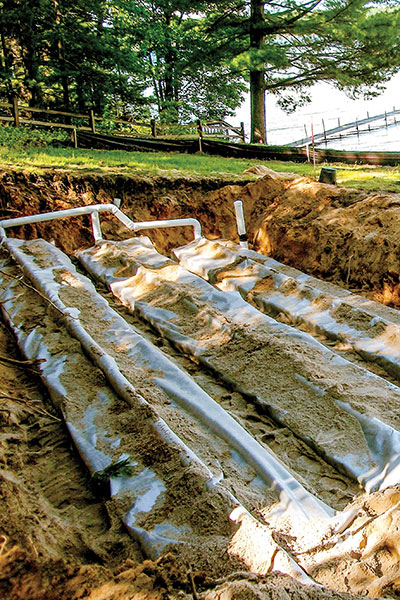
Extent of damage matters because one broken tee or coupling is not the same as multiple crushed laterals. A lateral is one of the perforated pipes that distributes effluent into the soil. Repairing one lateral can be a localized dig. Replacing several laterals means more trenching, new pipe, new stone or chamber material, and more restoration.
Soil condition matters because a drain field works by letting effluent percolate through unsaturated soil. If the soil is compacted, saturated, or too fine-textured, a repair may not restore function for long. Then the pipe is only half the story. The absorption area is the real issue. That’s why some jobs end with a recommendation for a new field, an alternative trench layout, or an advanced treatment unit. Those options cost more than a simple fix, but they can be the durable answer when the original field cannot be restored. For site-specific design decisions, consult a septic professional. According to the U.S. Environmental Protection Agency, local soil and site conditions are central to septic system performance. EPA septic systems guidance
Local rules also change the number. Some jurisdictions require permits, inspections, or soil evaluations before a field repair. A permit fee may only be a few hundred dollars, but a site evaluation, perc test, or engineered design can add much more. If your county or health department requires a stamped plan, the total cost can rise quickly even when the physical repair is modest. The paperwork can bite. For example, the EPA notes that maintenance and inspection schedules vary by system type and local rules. EPA septic systems guidance
What kind of repair are you actually paying for?
Usually, you’re paying for one of four things: diagnosis, localized repair, partial field replacement, or full drain field replacement. Each one has a very different price profile.
Diagnosis is the first billable step. A contractor may inspect the tank, check the distribution box, test flow to each line, and look for wet areas. That can mean a service charge plus labor. If the system is older, the contractor may also need to pump the tank before the field can be judged accurately, because a full tank can hide downstream problems.
Localized repair can be the least expensive meaningful fix. That might include replacing a cracked distribution box, repairing a broken inlet pipe, re-leveling a box, or patching a short section of line damaged by roots or equipment. I’d file this under “keep the field, keep most of the piping, fix the weak link.”
Partial replacement is the middle ground. If a section of field is dead but the rest still functions, the contractor may replace one trench, a bank of laterals, or one field arm. This is common when part of the system was crushed, flooded by runoff, or overloaded by an earlier plumbing issue.
Full replacement is the expensive endpoint. If the field has reached the end of its useful life, repair money just delays the inevitable. At that point, you’re paying for new trenches or chambers, new distribution piping, possible tank upgrades, permit work, and restoration of the yard. Site work and permitting can cost as much as the visible piping. That’s not rare.
I would not pay for repeated temporary fixes if the same area keeps failing. Two or three “small repairs” can cost more than doing the real solution once.
How do I keep the repair from becoming a replacement?
Find the cause early, then stop the damage that’s still active. That’s the short version. The first goal is to reduce hydraulic loading, meaning the amount of wastewater entering the field. The second is to protect the field from compaction, roots, and surface water.
Start with the simplest checks. Make sure gutters, sump pumps, and downspouts are not dumping onto the drain field. Diverting surface water costs far less than repairing a saturated field. Keep vehicles off the area; even a light truck can compact soil and crush shallow piping. If you already know roots are intruding, have them cut back and the pipe assessed before they shear more joints.
If the issue is a pump system, verify the alarm, float switches, and breaker before assuming the field has failed. A failed pump can mimic a failed drain field. In that case, the repair cost may be a pump service call rather than trench work.
If the tank has not been pumped in years, schedule that first if a septic professional recommends it. A tank packed with sludge can send solids into the field, and once that happens, the drain field can clog from the inside. Wait too long, and the bill gets ugly.
For reference, the U.S. Environmental Protection Agency has a solid homeowner guide on septic systems here: https://www.epa.gov/septic. The National Onsite Wastewater Recycling Association also publishes practical guidance on onsite systems: https://nowra.org. Both are useful when you want to understand the system before you agree to a repair plan.
When should I stop trying to patch it?
Stop patching when the problem is no longer local. After that point, repair money is just chasing a system-wide failure.
Sewage is backing into the house: This means the system cannot move wastewater through the tank and field safely — stop using water heavily and get a septic professional to inspect the tank, baffles, distribution box, and drain field.
Wet, smelly, or blackened soil covers more than one area of the field: This usually means field-wide saturation or failure — do not keep digging one trench at a time; ask for a full evaluation and replacement options.
The same line fails again after a repair: This points to a root cause the first fix did not address, such as oversaturation, a crushed pipe, or a failing distribution box — stop paying for repeat patchwork.
There is a pump alarm, and the field is still not accepting flow: The issue may be electrical, mechanical, or hydraulic, not just the field — have the pump system checked before field excavation.
The system is under a driveway, patio, or mature trees: Access limits can make a repair more expensive than a redesign — compare the excavation cost against the price of partial or full replacement.
The septic tank has not been pumped in many years: Solids may already have migrated into the field — pump, inspect, and only then decide whether the field still has usable life.
The mistakes that make drain field repairs expensive
The costliest mistake is waiting until the field is visibly failing. By then, the repair often turns into replacement. A $1,500 fix becomes a $10,000-plus site project. That math stops working fast. Better to deal with slow drains, odor, or a small wet spot before the house backs up.
Another mistake is assuming the field failed when the pump failed. In pump-assisted systems, a bad float switch, tripped breaker, or dead pump can look like drain field failure. The result is needless excavation. The better move is to test the pump circuit and controls first.
A third mistake is letting heavy equipment drive over the field. Compacted soil loses permeability, and perforated pipes can crack. The result is a field that drains worse after the repair than before it. The correct alternative is to keep trucks and trailers off the absorption area and use light equipment or hand digging where possible.
A fourth mistake is pouring additives into the tank and hoping the field recovers. That creates false confidence and buys time for the clog to spread. The correct alternative is diagnosis, pumping if needed, and repair of the failing component.
A fifth mistake is choosing the cheapest quote without a diagnosis. That can mean paying twice when the “repair” only treats one symptom. The better alternative is to ask what part of the system failed, what was inspected, and what would make the estimate change.
What changes the answer in edge cases?
The cost answer changes sharply if your system is mound-based, in poor soil, or connected to an advanced treatment unit. A mound system is built above grade for sites with shallow groundwater or unsuitable native soil. Repairs there often cost more because the engineered fill, distribution network, and grading all matter. If the mound is eroded or saturated, the fix is not just a pipe repair.
If your property has high groundwater, sandy soil, or very clay-rich soil, a standard drain field repair may not hold. In those settings, the soils report and local code may push the project toward a different design, such as larger trenches, chamber systems, or an alternative treatment unit. Those are not cheap add-ons; they can shift the project from a repair into a redesign.
If the field sits under a finite easement or a small lot, replacement options may be limited. That can mean higher design and permitting costs because the contractor has fewer places to relocate the absorption area. Small lots often pay more per square foot because the solution has to fit the site, not the other way around.
If the problem is tree roots, the field may need a localized line replacement plus root management. Root damage is one of the few cases where the physical repair may be moderate but the recurrence risk stays high. I’d want the contractor to explain whether the roots came from the immediate vicinity or from a larger tree that will keep searching for moisture.
What should a good repair plan include?
A good repair plan should name the failed component, show how the contractor found it, and explain whether the fix preserves the rest of the field. That’s what separates a real estimate from a guess.
I’d want the plan to mention the tank, distribution box, lateral lines, and absorption area by name. If the contractor used a camera, dye test, excavation, or soil observation, that should be described. If the repair includes permit work, restoration, or pumping, the quote should say so plainly. “Septic repair” is too vague when the bill might run from four figures to five.
A strong plan also tells you what happens if the repair fails. If the contractor believes the field has only 1 to 3 years left, I’d rather hear that than get a polished but unrealistic fix. Honest bad news costs less than repeated spending. Usually.
FAQ: septic drain field repair cost
How much does a small septic drain field repair cost?
A small repair can be roughly in the low thousands, especially if the problem is localized to a box, fitting, or one short section of line.