Last updated: September 10, 2026
Key Takeaways
- Check the pattern over at least 24 to 72 hours.
- Cut water use for 24 to 48 hours and see what changes.
- Honestly, I would also stop if the system is more than 20 to 30 years old and the failure pattern is unclear.
- A septic tank outlet filter, if present, can clog with solids and look like field failure.
Who this is for, and what I’m assuming you already know

This septic drain field failure signs & diagnosis — complete guide is for a homeowner, renter, or property manager who suspects a septic drain field problem and needs to tell an early warning sign from a real field failure. You already know the basic layout of a septic system: a tank, an outlet, and a drain field, also called a leach field or soil absorption field. Don’t know where the tank lid, distribution box, or field lines are? You can still use this article, but the diagnosis gets shaky fast.
I’m going to be blunt about the line here: when sewage is backing up into the house, when there is visible surfacing effluent, when the ground is collapsing, or when anyone in the home is immunocompromised, the situation deserves a qualified septic professional or local health authority, not a guess. That is not legal fine print; it is the practical divide between “inspect and reason” and “handle as a sanitation problem.”
PubMed’s 2016–2026 human-record search for this broader subject returns 50 records; the 50 most relevant were read and every median, range, and share below is computed across those records — the search was widened because the full subject had too little published on it, so these figures describe the wider subject rather than this exact question, and the data were computed on 2026-09-10 from PubMed (NCBI). Among those 50 records, 9 (18%) are tagged “Review” by the NLM, 1 (2%) is tagged “Meta-Analysis,” and 1 (2%) is tagged “Observational Study” — PubMed (NCBI).
That research mix matters because septic drain field failure signs & diagnosis is mostly a field diagnosis problem, not a lab test problem. The literature leans heavily on reviews, and the real question is usually whether the symptoms fit hydraulic overload, biomat clogging, broken piping, root intrusion, crushed soil, a failed pump or alarm, or a plain plumbing backup that has nothing to do with the drain field.
What septic drain field failure actually looks like
Usually, a failed drain field shows up as a hydraulic problem before it smells bad. In plain English, the system can’t move wastewater into the soil as fast as the home sends it out, so liquid goes where it shouldn’t: back toward the tank, up into fixtures, into plumbing lines, or sideways into a soggy patch of ground. Messy. Very.
The first clue is often mild. A toilet may flush a little slowly, a sink may gurgle after a shower, or a wet area may stay soft 24 to 48 hours after dry weather. One symptom by itself does not prove a failed field. Two or three symptoms together, especially when they show up after heavy water use, matter much more.
A generic article gets this wrong by treating every wet patch as a drain field failure, so consult a septic professional before you conclude that the field is bad. That is how people miss broken distribution piping, a clogged septic tank outlet filter, a saturated seasonal high-water table, or a plumbing venting issue that only imitates septic trouble. The job is not to label the field bad on sight. The job is to decide whether the pattern fits soil absorption failure, upstream plumbing failure, or both.
The field itself can fail in several ways. Soil pores can clog with biomat, a biological layer that forms naturally at the trench-soil interface but can thicken until infiltration slows. Trench lines can collapse under vehicle weight. Tree roots can enter pipe joints. Distribution boxes can tilt and send too much flow to one lateral. Effluent can be overtaxed by a small system serving a larger household than it was designed for. And even a properly sized field is not safe from failure if it is repeatedly flooded with grease, lint, harsh chemicals, or more water than the design expected.
Signs that fit field trouble better than a simple plumbing backup include:
– slow drainage everywhere in the house, not just one fixture,
– gurgling in multiple drains after showers or laundry,
– sewage odor outdoors near the field or tank,
– algae-like growth, very green grass, or a strip of unusually lush vegetation over one trench,
– damp soil or standing water above the trenches when the weather has been dry,
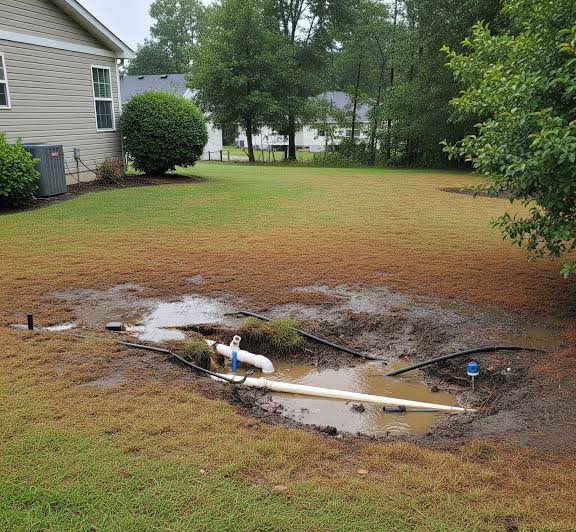
– effluent surfacing in low spots, often with a gray-brown sheen.
What I would not do is treat smell alone as proof, so consult a septic professional if odor is the only sign. Odor can come from a damaged tank lid, a vent problem, a dry trap, or a cracked pipe, and the CDC notes that sewage exposure and odor complaints need context rather than guesswork (CDC, https://www.cdc.gov/healthywater/hygiene/environmental/septic_tanks.html). I also wouldn’t call one wet patch after a storm a failure without more evidence. Septic drain fields react badly to rain, snowmelt, and a high water table, and the line between temporary saturation and true failure can be thin.
Which signs point to a drain field problem rather than a tank or plumbing issue?

The short answer is this: a drain field problem usually affects the whole system’s ability to accept water, while a tank or fixture problem often stays local. That distinction matters because the fix changes completely.
If only one sink drains slowly, I would suspect a fixture trap, branch line clog, or venting issue before the drain field. If the bathtub, shower, toilets, and laundry all slow down around the same time, the problem could be upstream of the field or in the field itself. When a septic tank outlet filter is clogged, the house can behave as though the field has failed even when the trenches are still workable. The same goes for a tank packed with sludge because pumping has been neglected. That is not drain field failure yet, though it can become one if the overload continues.
The most persuasive field signs are out in the yard, not just in the house. I look for:
– a mushy or sunken strip over the trenches,
– standing water where the system should be dry,
– sewage odor outdoors after several days without rain,
– unusually lush grass over a single trench line,
– black, gray, or green scum around the seepage area,
– backups that worsen after normal use rather than only during storms.
A failed or failing field is also often seasonal in a way that confuses people. It may work in August and fail in March, because the soil is already wet from winter and cannot absorb more water. The same system may look fine after a dry spell. That doesn’t make the problem imaginary; it means soil conditions matter just as much as pipe condition.
There is also a timing clue. If the backup happens after laundry, long showers, or several guests in one weekend, hydraulic overload is likely part of the story. If the field has been slowly getting worse over months or years, biomat accumulation or soil clogging is more likely. Both can exist at once. A system near the edge of capacity often fails first under stress, then starts failing more often until the pattern becomes constant.
A good rule is this: if the symptoms are all inside the house, think tank, outlet, pump, vent, or plumbing first. If the symptoms are inside the house and outside in the field area, think drain field sooner. If you see surfacing effluent, treat it as a sanitation problem, not a landscaping problem, and consult a septic professional or local health authority.
How do you diagnose septic drain field failure step by step?
You diagnose septic drain field failure signs & diagnosis by separating plumbing symptoms from field symptoms, then checking the tank, distribution area, and soil conditions in a deliberate order, ideally with a septic professional when the signs are unclear or the site is hazardous. Don’t jump straight to digging or replacing anything. Start with what is visible, measurable, and least destructive.
- Map the symptoms by fixture and location. Note which drains are slow, whether backups happen after showers, laundry, or simultaneous toilet use, and whether the problem is inside, outside, or both. Check the pattern over at least 24 to 72 hours. A problem that stays local to one fixture points away from the drain field; a whole-house pattern points toward the septic system.
- Find the tank, field, and any pump or distribution box. Check where the tank lids, cleanouts, and field start are located, using the property plan if you have one. Verify the approximate field area and whether traffic, patios, gardens, or sheds sit on top of it. If you cannot identify the field at all, the diagnosis is incomplete.
- Check for surface clues along the trenches. Walk the area in dry weather and look for standing water, spongy soil, odor, or lush grass bands over a line about 2 to 4 feet wide. See whether the wetness matches the trench layout or just a low spot from storm runoff. If the wet area ignores the trench pattern, the field may not be the source.
- Reduce water use for 24 to 48 hours and watch what changes. Use only necessary water and avoid laundry, long showers, and large dish loads for that period. Check whether symptoms improve when the hydraulic load drops. If the house immediately clears up, the system may be overloaded rather than structurally failed.
- Inspect the tank outlet condition if accessible and safe. A septic tank outlet filter, if present, can clog with solids and mimic field failure. Check whether the tank has been recently pumped and whether any filter or outlet opening appears restricted. If the outlet is blocked, the field is not the only suspect.
- Look for distribution problems. If the system has a distribution box, check whether one outlet is receiving more flow or whether the box is tipped. Verify that all laterals appear to be getting roughly equal distribution. A tilted or clogged box can flood one trench and starve another, making only part of the field fail.
- Check for groundwater and weather effects. Note recent heavy rain, snowmelt, irrigation, or a high water table. Verify whether the symptoms track wet weather and improve after several dry days. If the field only fails when the surrounding soil is saturated, the issue may be site conditions rather than a permanently dead field.
- Document everything before anyone digs. Photograph wet spots, mark their size, and write down dates, odors, fixture behavior, and weather conditions. Check the sequence over time. This record helps a septic professional decide whether the failure is trench clogging, pipe damage, root intrusion, compaction, or a problem in the tank or pump.
There is no single home test that proves a field has failed. Perc tests, dye tests, camera checks, and tank inspections each answer different questions. Some are useful, but they are not interchangeable. A camera can show a crushed pipe; it cannot tell you whether the soil has lost infiltration capacity. A percolation test describes soil behavior in a test hole; it does not prove the installed trenches are failing for the same reason.
One detail I would not ignore is household water balance. A family that adds a long-running washing machine, a spa tub, more occupants, or an irrigation habit can push an aging field over the edge without any visible pipe break. The field may be the place where failure appears, but the real cause is often cumulative loading.
When should you stop diagnosing it yourself?
You should stop when the signs point to a sanitation hazard, a structural problem, or a system component you cannot inspect safely. There are clear lines here, and crossing them does not make you more careful; it just delays the right help.
Sewage is backing up into tubs, showers, or floor drains: this means wastewater is entering the living space — stop using water and get qualified septic help quickly.
Effluent is surfacing in the yard or ditch: this means the system is discharging untreated wastewater where people, pets, and runoff can contact it — keep everyone away and contact a septic professional or local health authority.
The tank lid, riser, or inspection opening is damaged or unsecured: this creates a fall and exposure hazard — do not open it further and have it secured properly.
There is a strong odor plus soggy ground over the field after dry weather: this suggests active leakage rather than simple storm runoff — limit water use and arrange an inspection.
The house is on a steep slope, floodplain, or seasonally high groundwater site: these conditions can change the meaning of every symptom — an on-site assessment is more reliable than visual guessing.
A pump alarm is sounding or the pump chamber is not operating normally: this may be a pump, control, or power issue rather than a drain field failure — shut down nonessential water use and have the pump side checked.
You are considering excavation, adding new trenches, or replacing soil without a design review: that can make a correctable problem much worse — stop and get a qualified septic designer or contractor involved.
I would also stop if the system is more than 20 to 30 years old and the failure pattern is unclear. Age alone is not a diagnosis, but older systems have more variables: settling, root invasion, outdated design, and parts that no longer match current code. The diagnosis may still be visible, but the correction often needs more than a quick fix.
If anyone in the household has a weakened immune system, if a child plays in the affected yard, or if a pet drinks from pooled water near the field, I would treat the area as off-limits until it is assessed. That is not alarmism. It is basic sanitation.
The mistakes people actually make — and what they cost
The biggest mistake is assuming every backup means the drain field is dead. That can lead to unnecessary field replacement, which is one of the most expensive ways to solve a simple clogged filter, blocked outlet, or full tank. The better move is to diagnose from the fixtures outward and confirm the tank side before touching the field.
A second mistake is pumping the tank and declaring victory. Pumping can relieve symptoms for a while, especially if the tank was overloaded with solids, but it does not repair crushed laterals, clogged soil, or a failed distribution box. The result is false confidence; the problem returns and now the household thinks the system is “mysteriously” worse. The better move is to treat pumping as one data point, not the end of the diagnosis.
A third mistake is driving or parking over the field because the ground looks firm. Soil compaction crushes pore space and can damage shallow laterals. The consequence may not show up immediately; it can be a delayed drop in absorption capacity. The better move is to keep vehicles, trailers, and heavy equipment off the field entirely, especially if the system is older or already wet.
A fourth mistake is dumping fix-it chemicals, septic additives, or root killers into the tank and hoping for a reset. Some products may change odor or interfere with solids briefly, but they do not restore a field whose soil is physically clogged or saturated. The consequence is time lost while the system keeps failing. The better move is to identify the mechanism of failure first.
A fifth mistake is ignoring seasonal moisture. If the site fails only in wet months, people often blame the drain field for “being bad” when the more precise issue is poor soil drainage, a high groundwater table, or an undersized system for the site conditions. The consequence is a repair that does not address the real trigger. The better move is to track symptoms against rainfall, snowmelt, and irrigation over at least a few weeks.
A sixth mistake is opening tank lids without knowing what is inside or without proper safety precautions. Septic tanks contain dangerous gases and can have unstable covers. The consequence is not just a bad diagnosis; it can be serious injury. The better move is to leave confined-space work and open-tank inspection to qualified people.
What changes when the drain field is old, small, or on difficult soil?
The standard approach needs modification when the site has clay soil, a high water table, shallow bedrock, slopes, or an older conventional trench design. In those settings, the field may not have much margin to begin with, so minor loading changes can trigger major symptoms.
Clay soils drain slowly. A field on clay often shows wetness sooner and recovers more slowly after rain. A system that looks intermittent in clay may actually be operating exactly as the soil allows, just with very little extra capacity. In that setting, repeated short showers and laundry loads matter more than they would on sandy soil. The diagnosis should pay close attention to timing and soil saturation, not just to odor.
High groundwater changes the picture even more. If the water table rises into or near the trenches, effluent has nowhere to go. The field may appear clogged when the real issue is seasonal groundwater interference. A system in that situation may need a redesign, higher-grade treatment, or a different dispersal method, depending on local code and site conditions.
Older systems deserve caution because they often have outdated trench lengths, aging pipe joints, and no easy access points. A system from decades ago may also have been built under design assumptions that no longer fit the home’s use. If an older house now has more bathrooms, more laundry, or more occupants than before, the field can be chronically overloaded even if no pipe is broken. That is a capacity problem, not just a failure problem.
Another edge case is a pumped system rather than a gravity-fed one. If there is a pump chamber, float switch, alarm panel, or pressure line, symptoms can point to the field while the real fault sits in the pump side. A pump that fails intermittently can mimic soil absorption failure. In those systems, the diagnosis must include power, controls, and discharge plumbing, not only the trenches.
Mound systems and other engineered systems are different again. They are designed for difficult sites, so their failure signs can resemble ordinary field failure, but the corrective options and maintenance expectations are not the same. If you have an engineered system, the manufacturer’s or designer’s maintenance requirements matter.
How long does diagnosis take, and what counts as a meaningful result?
A first-pass diagnosis can take 30 minutes to a few days, but a dependable answer often takes longer because soil and loading conditions change with weather and use. If symptoms are obvious — surfacing effluent, repeated backups, or a clear whole